Singapore's Fall on 15 February 1942
The Narrow Road to the Deep NorthSingapore's fall on 15 February 1942 is presented as both an imperial turning point and the beginning of a long captivity for many Australian soldiers. Its consequences reach beyond the surrender itself: prisoners captured there were among those later sent to build the Death Railway, where military ambition was realized through forced labor and immense human loss.
A turning point in the war
The novel places the fall at the moment when one empire ends and another rises. By 1943, however, the Japanese Empire is overstretched and losing ground. The Allies are supplying the Chinese Nationalist Army through Burma, while American control of the seas makes land transport increasingly important to Japanese plans. Japan seeks to sustain its forces in Burma and pursue its ambitions in India, but lacks the money, machinery, and time to build the railway it needs. The fall of Singapore thus belongs to a larger reversal: a military victory gives way to strategic desperation and a vast construction project.
Australian prisoners and the railway
The novel distinguishes the broader population of Australian captives from the men sent to the railway. It gives the figure of 22,000 Australian POWs, most of whom surrendered at Singapore as a strategic necessity before the fighting had properly begun. Nine thousand would be sent to work on the Death Railway. The first Australian prisoners to leave Changi as Dorrigo Evans's J Force were not all captured at Singapore: the thousand men included Tasmanians and Western Australians surrendered in Java, South Australians surrendered at Singapore, survivors of the sinking of the destroyer HMAS Newcastle, and men from other military experiences. Their varied origins do not undo the force's identity as a group; even as deaths reduce its numbers, the men remain bound by their shared captivity and their belief in one another.
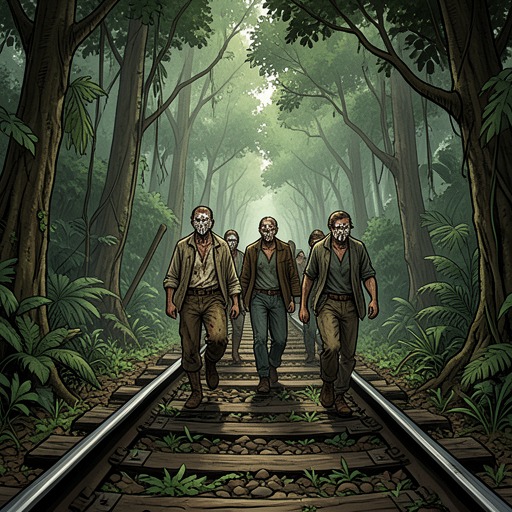
The railway's scale turns the consequences of the fall into a history of coerced labor. Its route was marked out as a 415-kilometre line from north of Bangkok to Burma. Prisoners were given blunt axes and rope to clear the planned path, then made to work with basic tools and their own strength. As labor demands intensified, the men were starved, beaten, and worked past exhaustion. A Japanese order to complete the railway even if most of the prisoners died makes explicit how the project treated their lives as expendable. On 25 October 1943, locomotive C 5631 traveled the completed line; the novel notes that the remains of one in three Australian workers would lie along it.
Captivity, uncertainty, and memory
For those outside the camps, the surrender also meant prolonged uncertainty. In Australia, there was no reliable testimony about the POWs in Asia and no real word of Dorrigo Evans's unit for nine months. Thousands of prisoners were believed to have perished, but there was no proof that Dorrigo was dead. The absence of news leaves families caught between fear and hope, while the novel's account shows how the fall's consequences continued in the form of waiting and incomplete knowledge.
The railway's human toll is itself uncertain. Allied POWs were only a fraction of the labor force: alongside them were hundreds of thousands of Asian laborers, and estimates of their deaths vary widely. The novel emphasizes that no agreed total exists and that many of the dead have no memorial book or recorded names. At Tokyo Yasukuni Shrine, locomotive C 5631 is displayed, but its plaque does not mention the horror of the railway's construction or the people who died building it. This contrast makes the fall's legacy more than a military chronology: it is also a struggle over which losses are recorded and which are left uncounted.
After the war
With the defeat of the Japanese Empire, the railway lost its military purpose and support. Its remaining workers were freed; the line was abandoned, dismantled, and sold off in parts. Rain, vegetation, and time then broke down its embankments, bridges, and cuttings. The novel's closing image of the line as a ruin, ultimately overgrown, counters the imperial ambition that had made it seem permanent. Singapore's fall opens the chain of events that leads to this project, but the line's eventual disappearance also underscores the difference between the endurance of human suffering and the impermanence of the structures built to serve power.